
Civil protection exercises
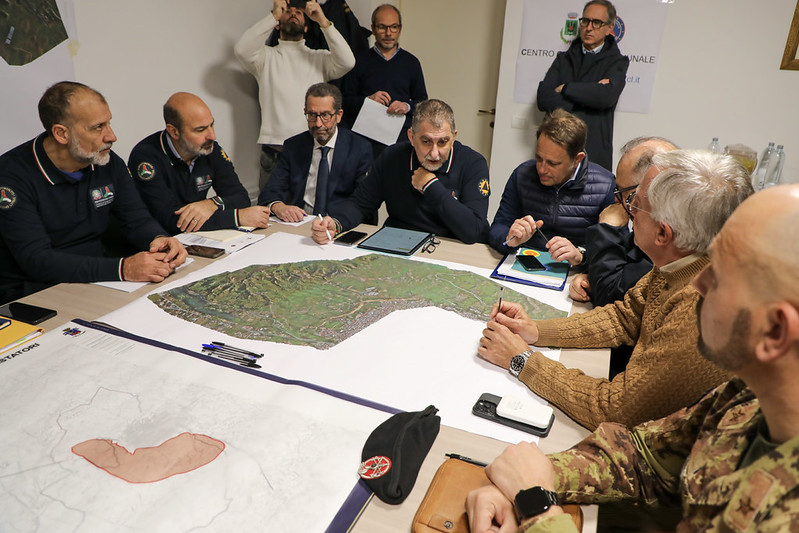
Civil protection exercises are a key tool for prevention and for testing emergency plans, with the aim of validating response models, updating knowledge of the territory, and assessing the adequacy of available resources. They also serve to train those involved in emergency management and to educate the population on the appropriate behaviour to adopt in emergency situations.
Exercises can be carried out on a national, regional, provincial and local level.
In national exercises, the National Civil Protection Service is involved when the scenarios require its mobilization, including the actual or simulated deployment of extraordinary resources. These exercises aim to verify the effectiveness of national-level plans, guidelines, and prevention and response measures. Accordingly, their planning and organization are the responsibility of the Civil Protection Department, which acts in coordination with the Regions or Autonomous Provinces in whose territories the exercises are conducted.
By contrast, regional, local, and sectoral exercises involve only the operational units of the National Civil Protection Service active at the regional, provincial, and local levels. Consequently, responsibility for organizing these exercises lies with the Regions or Autonomous Provinces, the Prefectures and Territorial Government Offices, local authorities, or other administrative bodies of the National Civil Protection Service, each acting within its respective sphere of competence.
The key elements needed to plan an exercise are laid out in the “exercise planning document”, shared with all participating administrations, which identifies, among other things, the scenario, the entities and authorities involved, the objectives, and the activity timetable.
Organizing an exercise requires a high degree of coordination, given the strong interdependence between the various activities involved in a system that brings together numerous personnel from different government agencies and organizations. The exercise process follows a structured sequence of planning activities, beginning with the conceptualization phase, during which the objectives are defined, and continuing through the planning, execution, and evaluation phases, before concluding with the implementation of the lessons learned.
Exercises are classified into different types according to whether the planned activities are actually carried out or are limited to simulated scenarios.
Command Post Exercises (CPX) are conducted exclusively within the operational centres activated at the various levels of the civil protection system, with the exercise scenario involving simulated activities, such as the deployment of resources. Their purpose is to verify the effectiveness of relationships and communications between the various centres, test decision-making processes and assess the time required to activate the coordination system, as well as the effectiveness of response procedures. Accordingly, these exercises do not involve any actual field operations, other than the activation and staffing of the operational centres involved.
Field Exercises (FX) involve the simulation of the various stages of activation, mobilization, and operational deployment of trained modules or teams. They include practical field activities, as well as the activation of operational centres and/or coordination and interaction with local authorities and other relevant stakeholders. This type of exercise is comparable to rescue drills.
Full-Scale Exercises (FSX), on the other hand, simulate a wide range of civil protection activities, from prevention and alerting to emergency management within the framework of the simulated scenario. In addition to activating the operational centres involved at all territorial levels and testing the communications network, these exercises also involve practical field operations, ranging from the deployment of resources to the active participation of the public.
In Table-Top Exercises (TTX), a simulated environment is created to reproduce, in whole or in part, the scenarios associated with a potential emergency event. The main objective is to assess and test decision-making processes in the context of existing civil protection plans and response models.
Finally, Discussion-Based Exercises (DBX) are primarily designed to evaluate specific procedures and activities; therefore, they consist of a discussion and exchange of views among the various simulation stakeholders.
As part of the Union Civil Protection Mechanism the European Commission entails training that includes exercises to simulate big emergencies.
International exercises are supported, also with specific financial contribution, by the European Commission and represent an important appointment for evaluation of: emergency management by countries taking part, intervention model, forms of collaboration between National Civil Protection Systems called upon to cooperate in the event of disasters in a foreign or European country.
The Civil Protection Department, in collaboration with the involved regions, promotes and organizes international exercises. These exercises address various types of risk and are designed to assess the effectiveness of activities and procedures implemented during emergencies.
Teams from different member states participate in an international exercise both as operational units, deploying personnel and equipment, and as observers, engaging in activities to better understand the participating teams, as well as to compare methods and procedures. All representatives of EU member states may participate as “observers,” with greater participation from those affected by the risk simulated in the exercise.